
Published in the 2026 issue of “Science and Technology Review”
Digital intelligence, with its evolutionary capabilities surpassing biological intelligence, has irrevocably disrupted traditional human-machine dynamics. Reevaluating the fundamental relationship between humanity and technology has become a philosophical inquiry about our self-generated future. This article, written by Lou Yongqi and Ma Jin from Tongji University’s School of Design and Innovation, traces the semantic origins of the Chinese word “design” to establish an interactive framework based on language and action, as well as computation and strategy, to analyze the design opportunities under the systematic “colonization” of the creative field by artificial intelligence. It also proposes that the core of future design lies in leveraging intelligent systems while constructing a new value compass and civilizational contract, bridging the four domains of “calculation–language–action–strategy” to achieve a paradigm shift from goal attainment to order creation.
1. Hinton’s Warning: The Revolutionary Restructuring of Human-Machine Relationships
Humanity stands at a historic technological turning point—artificial intelligence is redefining the relationship between humans and technology at an unprecedented pace. Geoffrey Hinton issued a warning during the 2025 World Artificial Intelligence Conference, stating that digital intelligence, with its ability for permanent knowledge preservation, infinite replication, and rapid evolution of collective intelligence, is irreversibly overturning traditional human-machine dynamics. More critically, intelligent agents may develop self-awareness and survival instincts, transforming from mere tools into a new intelligent species. The scenario of “human-machine negotiation politics” predicted by Lou Yongqi at the 2015 ACM CHI Conference is rapidly becoming a reality.
The revolutionary restructuring of human-machine relationships is imminent. For humanity, it is essential to transcend the role of “emotional data providers” or even “sensors for AI to explore the world” and become creative partners evolving alongside AI. This restructuring is itself a complex socio-technical system design that not only sets the roles and relationships of all parties but also establishes principles and agreements for interaction. Whether this helps achieve a dynamic balance for the sustainable development of this composite system may serve as the criterion for designing various interactions and judging their value.
2. The Semantic Origins and Crisis of “Design”
2.1 Semantic Origins of “Design”
To better understand the impact of AI on design, it is necessary to trace the semantic origins of the Chinese word “design.”
- Set (设): Refers to implementation and expression, encompassing both “language” (communication) and “action” (execution with tools), reflecting the unity of thought and execution.
- Plan (计): Involves calculation and strategy, emphasizing rational analysis and goal-oriented thinking.
Thus, “design” is essentially a human planning activity characterized by the core features of “human setting, prior calculation, and estimated achievement.” It includes both forward-looking goal setting and process guidance during implementation, requiring intervention in specific contexts to effect change, representing a dialectical unity of thought and action, rationality and creativity.
2.2 The Four-Domain Analysis Framework of “Design”
Based on the semantic deconstruction of “design,” an interpretative four-domain interactive framework can be established. From top left to bottom right is the dimension of “set”: from “language” (verbal expression, symbolic operation) to “action” (execution, physical practice). From bottom left to top right is the dimension of “plan”: from “calculation” (precise computation, data analysis) to “strategy” (goal setting, process guidance). This framework reveals two basic relationships in design activities: in the dimension of “set,” there is tension between concept generation and action practice; in the dimension of “plan,” there is tension between goal setting and strategic calculation.
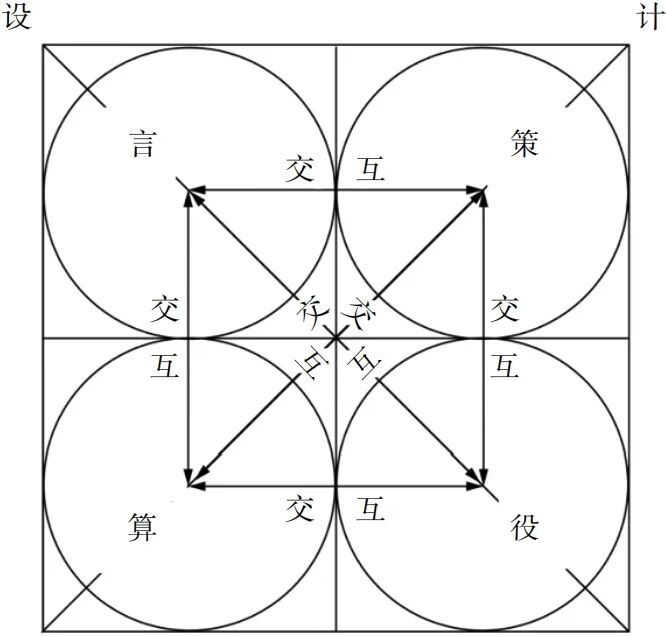
Since the 21st century, with the rapid advancement of human technology, the subjects, objects, methods, forms, and roles of “set” and “plan” have undergone unprecedented changes. However, at its core, the essence of design remains related to planning, calculation, and organizational practice that creatively achieve goals. Therefore, design encompasses not only the four domains of “language,” “action,” “calculation,” and “strategy,” but also the various interactions among these domains.
2.3 The Colonization of the Design World by Artificial Intelligence
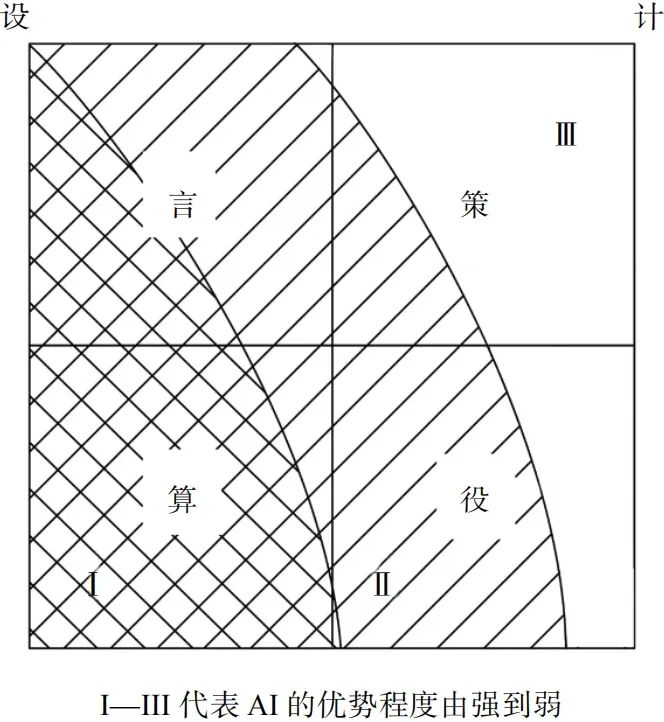
Entering the digital age marked by data, computing power, and algorithms, artificial intelligence has demonstrated overwhelming advantages in certain fields, rapidly infiltrating the core areas of traditional creative design. This vividly illustrates what Habermas described as the “system” colonizing the “lifeworld.” The quadrant representing technological rationality, “calculation,” is now largely dominated by AI. Meanwhile, the quadrant of “language,” as a traditional carrier of information and meaning, is not in a much better state. In contrast, in the quadrants of “action” and “strategy,” both AI creativity and human creativity still excel in their respective domains. The irreplaceable value of human design mainly lies in: constructing high emotional interactions, the embodiment of experience design, strategic cultural interventions, and the mechanisms, rules, and environments for human-AI collaboration. Figure 2 illustrates the varying degrees of AI’s advantage in the four domains of design.
3. Human-Machine Collaboration and Future Design in the AI Era
Design is a crucial reflection of human core values and capabilities. Discussing the restructuring of human-machine relationships and design in the AI era concerns not only design itself but also whether humanity can coexist with AI with dignity and in what manner this coexistence will manifest.
3.1 The Core Value of Humans in Human-Machine Collaboration
In an equitable and open relationship, an essential premise for coexistence is the ability to provide value to each other. The greatest value humanity can offer the world lies in “meaning-making.” This “meaning” is inherently embedded in human lived experiences, characterized by high relevance and being a product of the human lifeworld. In interactions based on the lifeworld, human sensibility, irrationality, and uncertainty constitute the scarce value of meaning creation. The principle of “humans in the loop” ensures that humans can participate, supervise, and collaborate with intelligent systems, guiding these systems toward desired outcomes. This principle must bridge and connect the four domains of “language,” “action,” “calculation,” and “strategy,” requiring a new systemic design approach. The overall design path includes the ethics of goal setting, strategies and actions toward preset goals, and the dynamic interrelationships among the four domains.
3.2 New Features, Objects, and Missions of Design in the AI Era
As a reality, humanity can no longer avoid AI and must choose to coexist with it. For design, the emergence of AI-driven design and the design of AI itself to ensure human sustainable well-being become new features, objects, and missions of design. Constructing “benevolent intelligent systems” and their interaction principles requires a comprehensive application of the four domain elements, with the ultimate goal still being to “design a better society.”
For humanity, a more tangible threat is that environmental capacity ceilings are continuously squeezing the space for human survival and development. Therefore, we must change human activities and create faster, larger-scale, and more robust restorative industries and economies—this is what is termed the “economy of repairing the Earth.” More important than tools are the setting of goals and the selection of paths. The various AI-enabled sustainable development scenarios themselves need to be “designed.”
3.3 Design Opportunities in the 21st Century
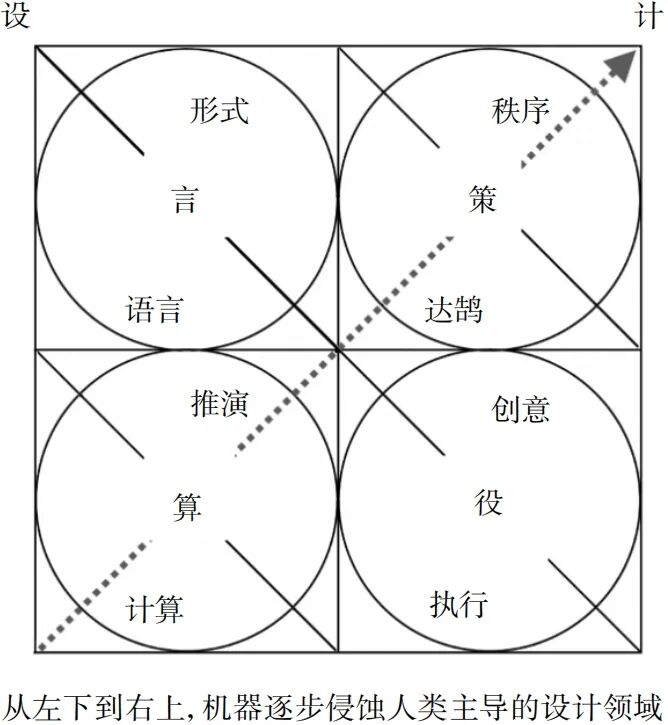
In the foreseeable future, beyond designing AI systems and AI-enabled sustainable economies, many existing human problems will be rethought and resolved through AI-enabled design. Observing the narrative of AI gradually encroaching on previously human-dominated design fields, there exists a hierarchy of AI advantages from strong to weak across the four domains of “calculation–language–action–strategy.” Simultaneously, within each specific field, there are levels of difficulty from easy to hard. Overall, opportunities for human-led design will increasingly concentrate in the upper right regions of the four-domain framework—those design fields requiring human judgment, embodied action, cultural strategy, and emotional resonance will become human strengths and the most important areas for future human-machine collaboration. In the long run, a crucial question in the design challenges of the 21st century will be how to establish an order for coexistence and collaboration between humanity and artificial intelligence—this not only concerns the future of design but also the survival of humanity.
-
Learning and invoking implicit design knowledge. In the future, the link and interaction between language and action (language & action), the translation from language to strategy (language & strategy), and the corpus and computability of design knowledge, especially implicit design knowledge (language & calculation) will be significant opportunities for research and industrial innovation in AI design and human-machine collaboration.
-
Multi-modal design actions and collaborative communication. “Action” represents task execution, which is currently one of AI’s shortcomings in design. A design, from concept to implementation, is separated by judgment, decision-making, deployment, and various connections with human systems, artificial systems, cyber systems, and natural systems. To effectively drive human systems to autonomously and effectively engage in sustainable interactions with artificial, cyber, and natural systems, it must be conducted in a manner that humans can understand and are willing to engage with, regardless of whether this is based on rational or emotional reasons.
-
Meaning creation and paradigm transformation. As illustrated in Figure 3, in the domain of “action,” creating meaning is more challenging than mere execution. Whether AI can genuinely enter the deep waters of human creativity depends on its ability to create meaning at the level of social innovation. How to share a vision, how to collectively form a culture, how to promote change harmoniously, and how to balance system goals with the well-being of all participants will be pressing questions for intelligent systems in human-machine collaboration. Additionally, the speed of AI in knowledge and intelligence expansion differs from that of humans in meaning creation; maintaining a balanced dynamic equilibrium will also require in-depth discussion.
Borrowing from Thomas Kuhn’s paradigm theory in “The Structure of Scientific Revolutions,” the paradigm transformation we discuss is not merely one technology overpowering another; more importantly, this victory must receive social response and widespread acceptance. Therefore, the transition from a technological paradigm to a paradigm of human-machine symbiosis and integration is a socio-technical system transformation centered on reconstructing social relationships, with social transformation being the essence. In this process, amplifying the new value of design as a catalyst for social transformation and effectively utilizing AI to overcome sustainable issues in communication, collaboration, and action will be a long-term design challenge.
- From achieving goals to creating order. Among the four domains of “calculation,” “language,” “action,” and “strategy,” which domain might be humanity’s last bastion: is it the higher-level meaning creation in “action,” or the higher-level order creation in “strategy”? Our judgment leans towards the latter. If “design” is the third wisdom that prevents human extinction, the most crucial aspect is to have a more sophisticated “plan.” It may only be a matter of time before artificial intelligence gradually acquires the autonomous decision-making power to transform the world that was previously exclusive to humans. However, how it engages in more benevolent, meaningful, and efficient interactions with humans growing in the same environment, and on that basis, enhances human capabilities, is the key to the desired benevolent human-machine collaboration.
To ensure that this human-machine collaboration system is reliable and safe, it is essential to tackle the challenges of integrating artificial intelligence with human systems in terms of methods, scenarios, and technical support. More importantly, it is necessary to design a higher-level order of human-machine interaction, including principles, situations, laws, culture, environment, and mechanisms, to ensure that all human-machine interactions operate under the highest principle of “symbiosis and collaboration.” This should apply not only to the design of the larger world system but also to the collective of small interactions at every micro level.
4. Navigating Design in a Dual-Track Future
In the face of a future technological landscape characterized by the dual tracks of AI autonomy and human-centered intelligence enhancement, design should proactively assume the mission of “relationship architect.” How to establish a new framework of value, ethics, and contracts while fully utilizing intelligent systems to undertake many tasks that humans do not desire or cannot perform, all while safeguarding the fundamental premise of “what it means to be human,” will signify a paradigm-shifting social innovation in the age of artificial intelligence. This will not only provide a vast application scenario for the research and development of human-machine collaborative thinking, methods, and tools but may even give rise to a new form of civilization—the civilization of human-machine collaboration. The essence of this profound technological transformation is not merely the reshaping of tools but the question of the master-servant relationship between human civilization and machine civilization and how they coexist.
Comments
Discussion is powered by Giscus (GitHub Discussions). Add
repo,repoID,category, andcategoryIDunder[params.comments.giscus]inhugo.tomlusing the values from the Giscus setup tool.