Introduction
The release of Qwen3.6-Plus is revolutionizing the programming landscape. This AI tool, equipped with the ATH architecture and 1M context, can autonomously debug code and understand your aesthetic intentions through “Vibe Coding.” When product managers can create 3D games with just a few sentences, we must rethink what true competitive advantage is in the AI era.

If you had asked a seasoned driver in 2000 how to drive, they would have discussed clutch control and gear shifting. Back then, driving was a skill that took time to master. With the advent of automatic transmissions and intelligent driving, today’s youth can simply focus on the road while the car handles the rest.
Now, the programming world is at a similar turning point with the rise of “automatic programming.”
In early 2026, Alibaba quietly released Qwen3.6-Plus. After its launch, several product managers in my circle, who previously struggled with HTML, managed to create 3D-rendered games in just one afternoon. This new approach is referred to as “Vibe Coding.” Some even jokingly say this AI is as considerate as a “digital companion”—just give it a glance or an emotion, and it gets the job done.
As a veteran in the internet industry, my biggest takeaway after testing Qwen3.6-Plus is that the era of “coding” might truly be coming to an end. In the future, our competitive edge will lie in our ability to “tell stories” and “control the pace.”
Breakdown of Qwen3.6-Plus: What Makes It Stronger?
Many articles about AI tend to pile on various parameters, but let’s focus on two direct improvements.
1. It Can “Think and Act” Simultaneously (ATH Architecture)
Previous AIs were like obedient but rigid interns. You’d ask them to write a login page, and they would churn out a bunch of code. If it didn’t work, you’d have to provide feedback for them to revise it, which was frustrating.
Qwen3.6-Plus utilizes the ATH (Agentic-Task-Hybrid) architecture, essentially giving the AI a “self-check loop.” After generating code, it runs it in its own sandbox. If it encounters errors, it fixes them itself. What you receive is a nearly functional “product.”
2. Its Memory is Ridiculously Large (1M Context)
Previously, when we fed AI a PRD (Product Requirement Document), it would often lose track halfway through, leading to conflicting logic in the output. Now, Qwen3.6-Plus supports 1 million tokens of memory. This means you can input your entire project’s codebase, multiple PRDs, and even your company’s hundreds of pages of UI design specifications. It retains every detail, preventing issues like “fixing one wall while collapsing another.”
What is Vibe Coding? How Does It Simplify Programming?
“Vibe Coding” translates to “coding by feel.” It may sound abstract, but let me share two real cases from my testing.
Case 1: Creating a 3D Scene with a Single Sentence
I wanted to test its visual rendering capabilities. Without providing any technical parameters, I sent it a rough sketch of a snowy mountain and said:
“I want a scene reminiscent of ‘Zelda,’ with a bright sky, cold snow-capped mountains, and sparkling snowflakes drifting down. I want the camera to move with the WASD keys.”
Result: It didn’t mention Three.js or WebGL. In under a minute, it produced a 3D scene that ran in the browser. The gravity of the snowflakes, the drift of the wind, and even the smoothness of the camera movement were all perfectly adjusted. This is what we call Vibe. I didn’t need to understand the code; I just needed to appreciate the aesthetics.
Case 2: Fixing Messy Code
I fed it a piece of chaotic code written by a freelancer. Previously, AI might have suggested rewriting it. However, Qwen3.6-Plus responded interestingly: “Boss, this logic is indeed convoluted. I’ve filled in the gaps for the payment redirect and swapped out the slow image compression algorithm. Let’s see if the feel is smoother now.”
Why Do People Call It a “Digital Companion”?
While the term may seem playful, it represents a significant advancement in AI interaction.
It “chats”: Unlike Claude, which behaves like a polite butler, Qwen feels more like a seasoned colleague who can catch all your casual remarks.
It has “long-term understanding”: It remembers your preferences (like a minimalist style or dislike for a specific plugin). Over time, you can simply send an emoji or say, “It’s missing something,” and it can guess what you want to change.
This kind of “emotional alignment” greatly reduces communication costs. Previously, we had to write hundreds of words in prompts; now, it feels like conversing with family—just a few words will suffice.
Qwen vs. Claude: Can Domestic Models Compete?
Let’s look at a direct comparison.
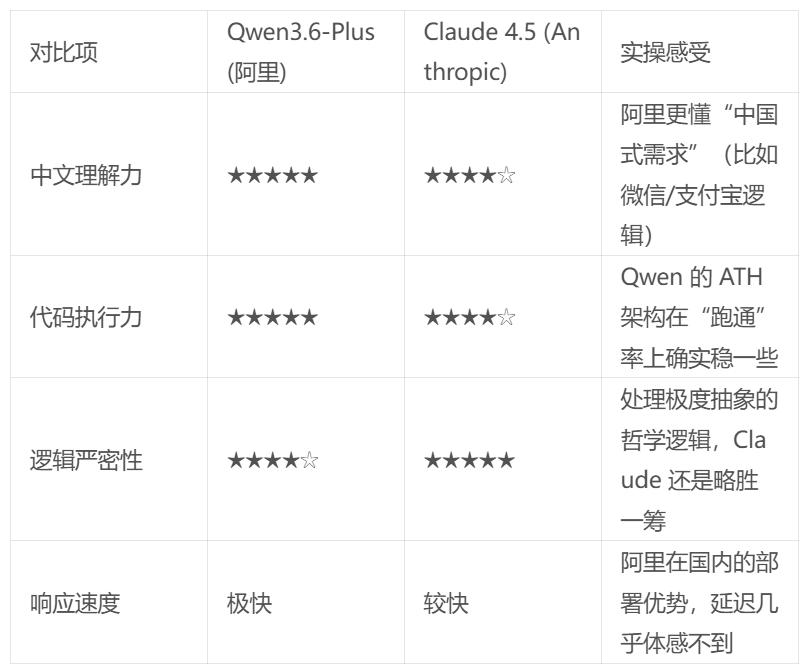
Veteran’s Opinion: We used to think domestic models were “low-end,” but with the release of Qwen3.6-Plus, it has proven to be on par with top-tier Silicon Valley models in terms of practicality and implementation efficiency. In fact, when it comes to localized services (like integrating various domestic APIs), Qwen is the more effective tool.
What Will Our 3 Million Programmers Rely on in the Future?
Many programmers and product managers may feel anxious reading this: With the barriers lowered, doesn’t that devalue my skills?
In fact, it’s the opposite.
Previously, a good programmer spent 80% of their energy dealing with syntax errors, compatibility issues, and environment setups. Now, these “dirty jobs” can be handled by Qwen.
Your core value will shift to two areas:
- Problem Definition Ability: Can you identify the real pain points of users at a glance?
- Aesthetic and Control Ability: Can you choose the smoothest and most profitable option from ten proposals generated by AI?
Methodology: How Can Ordinary People Get Started with Qwen3.6-Plus?
Don’t just watch the excitement; I’ve summarized a practical “three-step” approach you can directly apply.
Step 1: Provide Your “Worldview”
Don’t start with demands. First, package your project background, existing code files, and PRD documents and feed them to it. One-liner template: “Qwen, you are my CTO. Here’s all our current information; please understand it. From now on, all our discussions will be based on this tech stack (like Vue+Tailwind).”
Step 2: Speak “Human Language” and Set the “Vibe”
When writing prompts, avoid rigid commands. Comparison:
- Wrong Example: “Please help me write a button, 200px wide, blue background.” (This is like treating it as a typist)
- Correct Example: “Qwen, I need a payment button. It should have a ‘premium feel,’ with soft feedback when pressed, and the color should make users feel their money is well spent. The logic needs to be extremely tight, with no exceptions overlooked.”
Step 3: Take Small Steps and Quickly Adjust
Don’t expect to achieve everything in one go. Start by having it write the core module and get it running. Then say, “The current UI feels a bit outdated; let’s add a cyberpunk vibe.” This iterative approach is much more efficient than writing thousands of lines of code all at once.
Conclusion: Embrace It or Watch Others Embrace It
In the internet industry, every few years, a massive wave comes crashing in. The last one was mobile internet; this time, it’s AI agents.
The emergence of Qwen3.6-Plus is essentially rescuing us from the tedious hell of coding. It’s not here to replace you; it’s here to offer you a private jet.
The “programming barrier” has indeed shattered. Now, the only limit is your imagination.
Try it out, even if you just want to create a digital photo album for your partner or a tool to automate your weekly reports. Once you experience the joy of “thinking and getting it,” you’ll never want to go back.
Comments
Discussion is powered by Giscus (GitHub Discussions). Add
repo,repoID,category, andcategoryIDunder[params.comments.giscus]inhugo.tomlusing the values from the Giscus setup tool.